
Your needs, this model
Does it fit your priorities?
Would an 8 mm graphite pencil fall inside Blue PSC5BL's published range?
AFMAT's exact PSC5BL page and PSC5 manual state a 6.5–10.5 mm range and name graphite, so 8 mm is inside the maker-stated interval. AFMAT says pencils shorter than 79 mm eject without sharpening. Check the widest shaft point, profile and length; no individual pencil was tried.
Explore this need in the finder →Can Blue PSC5BL sharpen away from a power outlet?
No cordless mode is documented for PSC5BL. AFMAT identifies a corded U.S. plug at 120 V / 60 Hz; plan for a suitable outlet and check the unit label. The 36 W rating appears in the PSC5 family manual, not on the exact Blue page.
Explore this need in the finder →Does PSC5BL feed a pencil in and eject it at a selected point?
AFMAT's exact page and PSC5 manual describe an automatic feed/sharpen/eject cycle with five dial positions. The manual's specification table says there is no indicator light, so this is not an LED completion signal. A measured point length or independent stop test is not supplied.
Explore this need in the finder →Does PSC5BL document use with crayons or the full soft/waxy pencil group?
AFMAT names selected soft-core pencil examples and advises the blunt dial settings, but does not establish crayons, chalk or every waxy core. That narrower advice does not satisfy the finder's broad soft/waxy requirement.
Explore this need in the finder →Will PSC5BL operate with its shavings drawer removed?
AFMAT says the sharpener will not operate unless the drawer is seated correctly. This is separate from its automatic point stop and is manufacturer documentation, not an independent safety test. Unplug before emptying and reinstall the drawer fully.
Explore this need in the finder →Is a dedicated anti-clog gear documented for Blue PSC5BL?
No source inspected here names a special anti-clog gear. The manual's broken-lead clearing procedure and blunt-setting advice do not prove one is present; its status remains unknown rather than physically disproved.
Explore this need in the finder →The AFMAT PSC5BL is the Blue version of AFMAT’s corded PSC5 pencil sharpener. Its official U.S./English product page describes automatic feed and ejection, five point settings, a 6.5–10.5 mm pencil range and a drawer that must be fitted for operation. This is a source-based assessment, not a hands-on test; the advertised speed, capacity and durability figures were not independently checked.
Keep PSC5BL distinct from the similarly named rechargeable PSX5BL
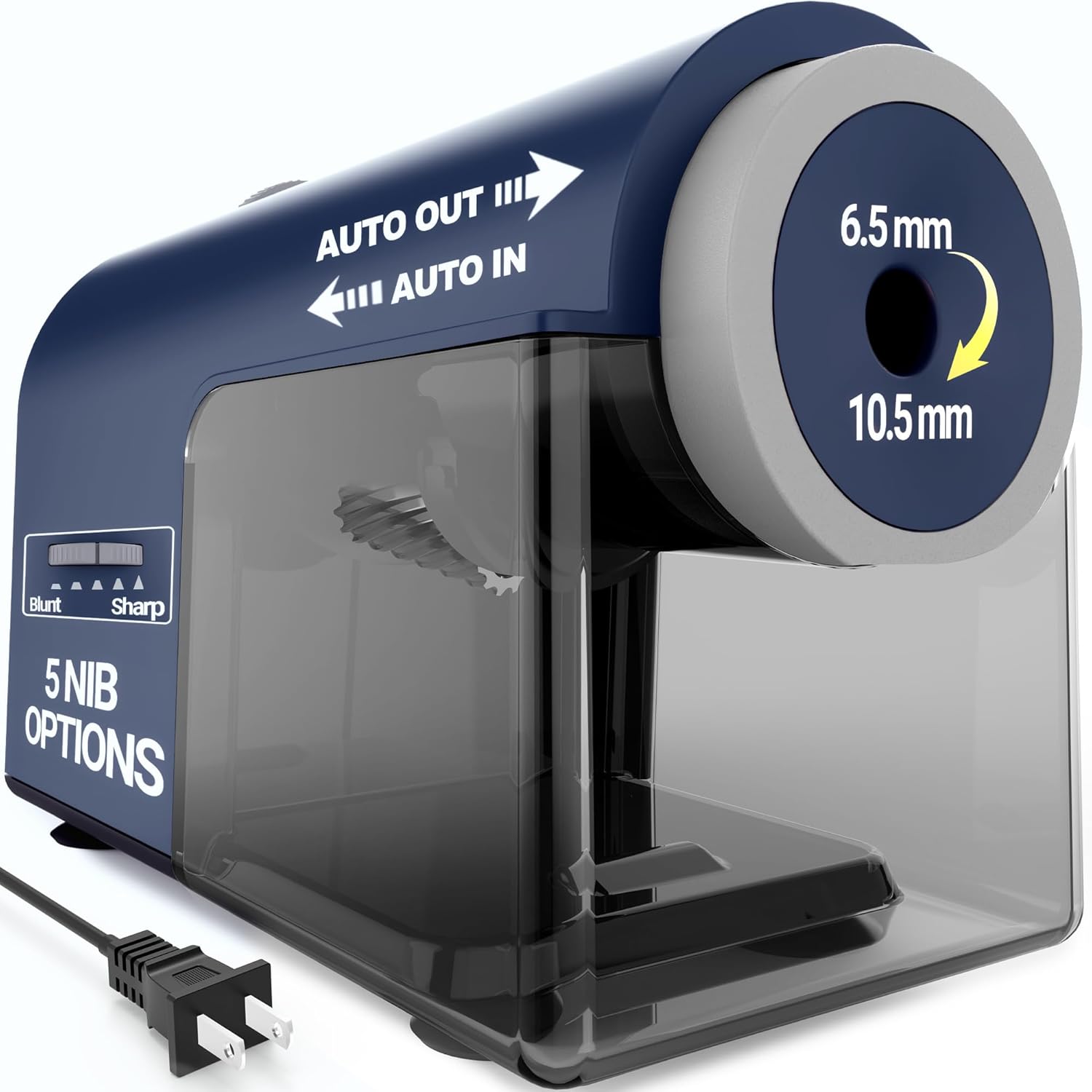
AFMAT’s saved U.S.-store collection record identifies the blue PSC5BL as a separate catalog product and selected variant, with the SKU PSC5BL. The product page itself repeats PSC5BL and shows Blue as its selected color. That suffix matters: AFMAT also lists a different rechargeable model called PSX5BL. Do not treat the extra “X” as decorative or assume the rechargeable machine’s pencil range, battery arrangement or other claims apply here. The pictured blue PSC5BL is useful for confirming the finish and visible drawer, but the artwork is not a delivered-box photograph or proof of how a particular seller packages it.
Five point choices with automatic feed and ejection
The PSC5 manual describes a five-position dial. After selecting a point, the user inserts a pencil and presses lightly to start; the motor then feeds the pencil, sharpens it and ejects it when the selected point is ready. The manual says there is no indicator light, so automatic ejection is not the same as a visible LED completion signal. AFMAT’s phrases about a “perfect” or ready point are not numerical geometry: neither a point length nor a repeatability test is supplied. If you need a particular measured tip profile, the documentation here does not establish one.
The page advertises three seconds for a used pencil and five seconds for a new pencil. It also describes quiet operation and more than 500 consecutive pencils. Those are manufacturer claims, not observed performance. They should not be used to plan a class’s sharpening throughput without checking the specific pencil stock and allowing for pauses.
Check the shaft, media and length before relying on the range
AFMAT states a diameter range of 6.5–10.5 mm and names graphite, colored, sketch and charcoal pencils; the product copy also lists round, oval, triangular and hexagonal shafts. These are useful screening claims, not a measurement of the opening or a fit test for a pencil you own. Check the widest part of the pencil and its profile. The manual says pencils shorter than 79 mm are ejected without sharpening; the page describes 79 mm as its short-pencil limit, so pencils at that edge deserve a separate check.
For selected soft-core pencils, AFMAT names examples including Prismacolor, Faber-Castell and Conté à Paris and recommends using the blunt end of the dial to reduce breakage. That advice is narrower than universal soft or waxy compatibility. It does not document crayons, chalk or every colored-pencil formula. If those materials are essential, do not read the broad “colored pencil” wording as evidence for them.
A fixed outlet station, with a separate drawer safeguard
The exact Blue page says corded U.S. plug, 120 V and 60 Hz. The PSC5 family manual lists 36 W, but the Blue product page does not repeat wattage; check the actual unit’s rating label and available outlet. No battery or cordless operating plan is documented for PSC5BL. The manufacturer lists a 7.5 × 3.5 × 4.7 inch body and four suction cups. Those dimensions are product-page figures, not measurements, and the cord’s length is not specified. Leave room to place it and pull out the clear drawer rather than assuming the listed footprint is the only clearance needed.
AFMAT and the manual both say the sharpener will not operate if the shavings drawer is missing or not seated correctly. This interlock is distinct from stopping at the selected point. For emptying, the manual says to unplug first, advises emptying around one-third full, and shows the drawer pulling out. It also gives steps for clearing a broken lead and replacing the blade. The manual directs readers to search for HB08 replacement blades, but that does not verify that a particular seller includes one or that a current offer is the correct replacement. Confirm compatibility with AFMAT before ordering parts.
What the sources do not settle
The manual’s “What You’ll Get” list names one plug-in sharpener and one user manual; it is a family document, not an inspection of the seller’s current Blue box. Its cover and several diagrams use a black-looking PSC4-style illustration despite the PSC5 label, so those drawings are used only for textual operating guidance—not as evidence that a Blue PSC5BL unit has a particular internal assembly. The page lists a stainless-steel blade and claims up to 10,000 sharpenings or three times the life of standard sharpeners. No service-life test, electrical measurement, noise reading, individual-pencil fit test or safety certification check was conducted for this assessment.
Bottom line
PSC5BL is a reasonable candidate to compare for a fixed U.S. outlet station when five dial positions, automatic feed/ejection and the separately documented drawer interlock fit the job. Its Blue finish is the identified configuration, not a documented functional advantage over other PSC5 colors. Before buying, confirm the exact PSC5BL code rather than rechargeable PSX5BL, verify the rating label and seller package, and check the actual pencil’s diameter, shape and length—especially near the maker’s limits. The available evidence supports a careful shortlist decision, not a promise that every pencil or advertised workload will perform as claimed.
Key specifications
Key details at a glance
| Manufacturer SKU | PSC5BL |
|---|---|
| Pencil-size control | Manufacturer describes rotating the top dial among five point settings; resulting point lengths are not specified. |
| Point-stop feature | Automatic feed sharpen and eject at selected point per manual |
| Completion indicator | None |
| Documented pencil media | Woodcase graphite / Colored pencils |
| Stops at a sharpening point | Yes |
| Shavings-bin safety interlock | Yes |
| Shavings bin | Manufacturer describes a large drawer but gives no volume or capacity measurement. |
| Power arrangement | Corded, wall-outlet operation |
| Maker-stated minimum pencil diameter | 6.5 mm |
| Conservative numeric match ceiling | 10.5 mm |
| Minimum usable pencil length | 79 mm |
| Documented pencil shaft shapes | round / oval / triangle / hexagonal |
Use the exact model’s instructions for operating limits, supplied equipment and version differences.
Sources for this review
Sources for this assessment
- AFMAT All Pencil Sharpener saved collection row: product 7206584549440 / Blue variant 40915266437184 / SKU PSC5BL
- AFMAT exact U.S./English Blue PSC5BL product page, official browser observation
- AFMAT PSC5 U.S. English manual, nine-page family operating document reused from the saved capture
- AFMAT exact Blue PSC5BL page-linked official product image

Check your own needs against the model
Use the finder to apply the documented limits, then verify the exact model and package before choosing a seller.