
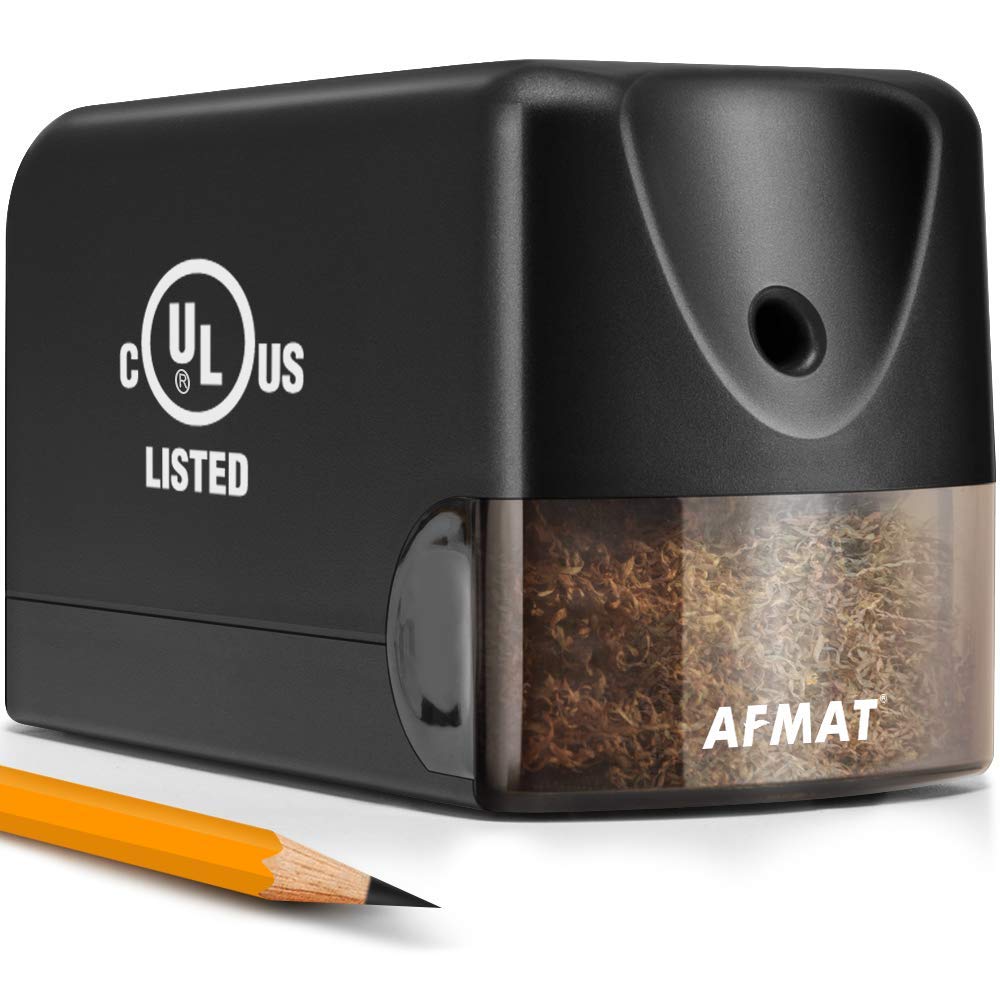
Your needs, this model
Does it fit your priorities?
Does the PS13 stop the motor when the pencil reaches its point?
AFMAT says the motor starts when a pencil is inserted, then tells the user to withdraw when the sound changes and resistance drops. The page does not document an automatic stop at the pencil point; this differs from the separate motor interlock when the shavings box is removed.
Explore this need in the finder →What pencil sizes and media does AFMAT state for the PS13?
The exact Black PS13 page states 6.5–8 mm and names No. 2 graphite and colored pencils. Treat the interval as manufacturer wording, check the widest part and profile of the actual pencil, and note AFMAT's warning about extra-soft cores; crayons and chalk are not documented as supported.
Explore this need in the finder →Can I use it at a fixed outlet and require a shavings-box switch?
AFMAT specifies a U.S. 120 V / 60 Hz plug and says the motor stops if the shavings box is removed or not tightly closed. That is a maker-described bin interlock, not proof of a point stop or child-proof protection.
Explore this need in the finder →A corded sharpener for a narrower pencil range
The Black AFMAT PS13 is easiest to assess as a fixed-station machine rather than a general-purpose jumbo sharpener. AFMAT's exact product page identifies the selected configuration as PS13 and states a 6.5–8 mm range for No. 2 and colored pencils. It lists a U.S. 120 V, 60 Hz plug, so the documented arrangement belongs beside an outlet. This is a maker-stated interval, not a measured opening or a fit test on any individual pencil.
That band is useful if the regular pencil stock is known to fall inside it. It is not evidence for larger triangular school pencils, thick art pencils, or unusually wide colored pencils. The page gives no named shaft profiles or minimum pencil length. Measure the widest part of the pencil you actually use and confirm the cross-section with AFMAT or the exact seller before relying on the claimed range. The machine has a single horizontal insertion path, not multiple holes or a published diameter dial.
Automatic starting is not an automatic point stop
The language around “automatic” deserves care. AFMAT says the motor begins when a pencil is inserted, then tells the user to withdraw the pencil when the motor sound changes and the resistance against the pencil eases. That describes automatic start with a user-managed finish cue. The page does not describe a flyaway cutter, a timed cutoff, or a point-triggered motor stop. If your priority is a machine that stops itself at the intended point, do not treat the PS13's start behavior as satisfying that requirement.
There is a distinct safety response at the shavings box: AFMAT says the motor stops when that box is removed or not fully closed. That is a bin interlock, not a pencil-point control. The listing also says sharpening may stop if too many pencils cause the unit to overheat, but gives no temperature, cooldown interval, or continuous-duty schedule. The separate behaviors should not be collapsed into a single “auto-stop” label.
What the pencil claims do—and do not—cover
The exact page names graphite and colored pencils, including several familiar colored-pencil lines, which is more specific than a generic “all pencils” promise. But it warns against extra-soft-core pencils because they can jam the cutter. This review therefore does not treat ordinary colored-pencil compatibility as a promise for every soft, wax-rich, fragile, or specialty core. AFMAT's warning is narrower than a full test across crayons, chalk, or all waxy media, and none of those broader materials is documented as supported here.
The product page calls the cutter helical and claims more than 10,000 sharpenings and a 3–5 second sharpening time. Those are manufacturer claims, not independently measured life or speed results. It also says the machine had no issue after sharpening 100 pencils at a time. That statement is not a published duty-cycle specification and does not show that the unit can run classroom loads continuously without cooling. For a classroom, check the current written instructions for pauses, jam clearing, and thermal recovery rather than treating “heavy duty” as a maintenance plan.
Footprint, bin, and missing service details
AFMAT lists dimensions of 3.1 by 6.2 by 3.8 inches and describes non-skid pads underneath. Those numbers are useful for an initial desk-space check but remain manufacturer figures, not measurements made for this assessment. The page does not give a numeric shavings-bin capacity, so a large class may need more frequent emptying than the marketing phrase “heavy duty” suggests. Remove and replace the box as instructed; do not reach into the cutter opening while the unit is powered.
I checked AFMAT's public support-documents index, which listed manuals for PSX, PSC, and PSD families but no PS13 booklet in that index. That does not prove no PS13 instructions exist elsewhere, so confirm the exact included guide. The public page also does not establish a PS13-compatible replacement cutter, an LED completion light, a named anti-clog cutter gear, or a shaft-shape chart. The product page uses “UL listed” wording and gives the designation S230; I did not independently verify that designation or establish that it maps to this retail SKU.
How it compares with broader AFMAT alternatives
The PS13's clearest tradeoff is its combination of a corded station, a documented box interlock, and a comparatively narrow stated pencil band—without an automatic point stop. The Black AFMAT PS92 is also corded but has its own 6–12 mm claim and a maker-described point stop; its exact sources do not document the PS13's bin-removal interlock. The rechargeable PSC7BK also states 6–12 mm and automatic feed/eject, but is built around a cordless routine and a different feature set. These models are not interchangeable variants: compare the exact suffix, plug or adapter, size evidence, and stop behavior rather than assuming shared AFMAT branding means shared mechanisms.
For the PS13, check the exact Black SKU PS13, U.S. plug and voltage, the pencil's measured diameter, the actual shaft profile, and whether you are comfortable withdrawing at the maker's sound/resistance cue. If extra-soft cores, a wider pencil, cordless use, or a point-triggered cutoff is essential, select a different documented configuration instead of stretching the PS13's claims.
Key specifications
Key details at a glance
| Manufacturer SKU | PS13 |
|---|---|
| Point-stop feature | Afmat describes automatic motor start after pencil insertion, then instructs the user to withdraw the pencil when motor sound changes and resistance decreases; no automatic point-triggered motor cutoff is documented. |
| Documented pencil media | Woodcase graphite / Colored pencils |
| Stops at a sharpening point | No |
| Shavings-bin safety interlock | Yes |
| Power arrangement | Corded, wall-outlet operation |
| Maker-stated minimum pencil diameter | 6.5 mm |
| Conservative numeric match ceiling | 8 mm |
Use the exact model’s instructions for operating limits, supplied equipment and version differences.
Sources for this review
Sources for this assessment
Check your own needs against the model
Use the finder to apply the documented limits, then verify the exact model and package before choosing a seller.