
Your needs, this model
Does it fit your priorities?
Will the Black PS106 support a 7 mm graphite pencil at a fixed work spot?
AFMAT names graphite and standard No. 2 woodcase pencils and states a 6–8 mm band, so 7 mm falls within its maker-stated range. It is not a fit test for your pencil's profile. The listed arrangement is corded; check the exact unit label before use because the published frequency string is unclear.
Explore this need in the finder →Does PS106 manage the point and stop if the drawer is open?
AFMAT says the cutter stops shaving after its ideal point is reached, and separately says the sharpener will not run with the shavings box removed or not tightly closed. The point claim does not specify geometry or say the motor stops; neither feature is an independent safety test.
Explore this need in the finder →Is PS106 a documented choice for crayons, chalk or soft waxy pencils?
No. AFMAT explicitly says those materials may jam the cutter and are not suited to this model. The ordinary colored-pencil claim does not override that warning, and AFMAT does not name an anti-clog gear.
Explore this need in the finder →What the Black PS106 assessment covers
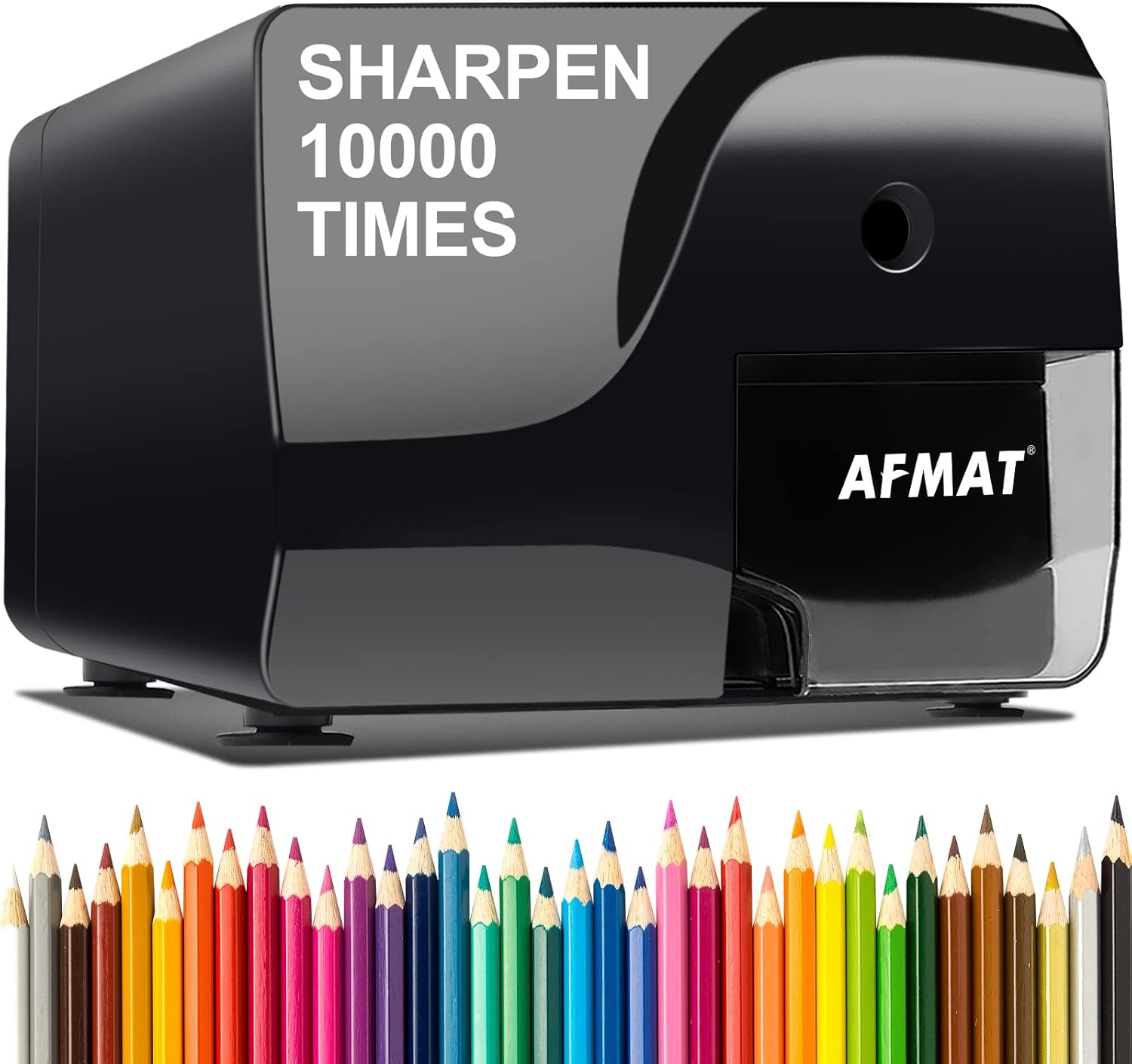
The AFMAT PS106 reviewed here is the Black model named on the brand's U.S.-English product page. AFMAT describes a corded sharpener for 6–8 mm woodcase pencils, including ordinary graphite, standard No. 2 and colored pencils. Its fit, point, speed and cutter-life figures are manufacturer claims, not measurements made here.
Model identity matters because AFMAT also lists a Blue PS107 and Green PS108 with different product and variant identifiers. Their similar-looking publicity images do not establish that they are interchangeable, share the same power unit, or have identical supplied accessories. This page stays with Black PS106 and does not map its results onto either sibling code.
A narrow stated range for ordinary woodcase pencils
The strongest fit information is the maker-stated 6–8 mm band and named graphite, No. 2 and colored-pencil uses. That is a useful screen for a desk, classroom or studio where most pencils are familiar woodcase sizes. It is not a gauge of the sharpener's actual opening, a fit test for a particular pencil, or a list of supported shaft shapes. AFMAT does not say whether a triangular, oversized, unusually lacquered or ferruled barrel fits, and it gives no minimum pencil length. Measure the widest point of a representative shaft and check it against the actual product rather than forcing an uncertain pencil into the opening.
The colored-pencil wording should not be stretched to every art medium. AFMAT explicitly warns that crayons, chalk and soft waxy pencils may jam the cutter and are not suitable for this model. Colored pencils differ in core softness and binder, so a generic color-pencil label is not evidence for a wax-rich or extra-soft core. The page does not identify a named anti-clog gear. If those softer media are central to the task, select a model whose exact documentation addresses them instead of assuming the PS106's broad colored-pencil claim covers the mix.
Three point choices, with limited geometry information
AFMAT names sharp, medium and blunt selector positions. It also says the blade stops shaving once the point is ideally sharp, even if pressure continues. That supports a maker-described point-stop effect, but the page does not say the motor shuts off, give an angle or length, or test how the settings behave with different cores. Treat the labels as selection language, not measured point geometry.
The detail page says sharpening begins when a pencil is inserted and light pressure is applied. AFMAT does not document a completion lamp. It separately says the unit will not run when the shavings box is removed or not tightly closed. That drawer interlock is distinct from point control and is not a child-proof rating.
Do not treat the conflicting workload claims as a capacity rating
AFMAT advertises 3–5 second sharpening and a 10,000-use blade-life claim, but gives no test method or service-life definition. Its workload statements are inconsistent: one feature bullet says 100 pencils at a time without overheating, while the description/specification says 250 consecutively or at a time. These do not establish a dependable continuous-duty capacity, so this review does not rate the PS106 as a 100- or 250-pencil workhorse.
The title promotes 10,000-plus sharpenings while the detail page says up to 10,000; neither sets a tested minimum life. A helical-blade label identifies cutter style, not material, replacement interval or measured advantage. Do not plan a classroom workload around a number the manufacturer describes inconsistently.
Outlet setup, drawer condition and desk space
The exact PS106 detail calls this a plug-in unit and gives a 120 V wall plug and a 55 W figure. Its literal power string is printed as “120V-5/60Hz, 55W”; the frequency portion is unclear, so it should not be silently rewritten as a confirmed 60 Hz rating. Check the electrical label on the exact unit before use, especially if the seller's package or destination differs from the U.S.-English page. The manufacturer's package description names one sharpener and one user manual, but this does not verify every marketplace bundle, seller or return term.
AFMAT lists 5.70 × 4.72 × 4.13 inches and 2.2 pounds, without labelling the dimension axes. Four suction cups are described under the base, but not tested for stability. Leave access to the pencil opening and drawer. The reviewed material does not establish bin volume, a cleaning routine, cord length or replacement-blade compatibility.
Who should keep the PS106 on a shortlist?
Consider the Black PS106 if your normal pencils are woodcase graphite or colored pencils within the stated 6–8 mm interval, you have a suitable outlet, and the sharp/medium/blunt choices plus the maker-described drawer interlock suit your routine. Check your actual shaft shape and the exact unit's electrical label. It is not a supported fit for a required soft-waxy, crayon or chalk mix, and it is a poor evidence-based choice when you need a dependable continuous-duty count, a completion LED, a quantified point shape or a named anti-clog mechanism.
Keep the printed SKU and finish in view when comparing AFMAT models. Blue PS107 has a separate page despite similar claims, while Green PS108 is much less detailed. Similar photos or headlines do not establish interchangeable limits or packages; verify the exact seller label.
Key specifications
Key details at a glance
| Manufacturer SKU | PS106 |
|---|---|
| Point-stop feature | Afmat says that after the point is ideally sharp the blade will not shave more material even if the user continues to push. this supports only a maker-described point-stop effect; the page does not say the motor itself stops, specify a point length or angle, or provide independent repeatability results. |
| Documented pencil media | Woodcase graphite / Colored pencils |
| Stops at a sharpening point | Yes |
| Shavings-bin safety interlock | Yes |
| Power arrangement | Corded, wall-outlet operation |
| Maker-stated minimum pencil diameter | 6 mm |
| Conservative numeric match ceiling | 8 mm |
Use the exact model’s instructions for operating limits, supplied equipment and version differences.
Sources for this review
Sources for this assessment

Check your own needs against the model
Use the finder to apply the documented limits, then verify the exact model and package before choosing a seller.